Own your sending. Get everything else.
The big platforms charge by the contact and own the infrastructure. The cheap tools can blast but that's it. The open-source tools have the depth but come with a server to run.
RadarSend connects to the same sending provider. Same account, same domains, same reputation. It adds automation, segmentation, contact intelligence, and honest metrics — without a server to run.
The reasons are usually the same.
The big platforms bundle sending into a per-contact subscription. The list grows, the bill grows faster, and the sending reputation builds on an account that isn't yours. Some platforms review your content before they'll send it. Some freeze accounts because a campaign looked "risky" to an algorithm.
Self-hosting avoids all of that. An SES account costs pennies per thousand. The domains are yours. Nobody polices what you send. That's a good trade — until the tool runs out of capability and the server starts feeling like a second job.
We ran our own sending for years.
We built what we couldn't find.
We ran email programs — newsletters, product updates, re-engagement campaigns — on our own infrastructure for over two decades. DKIM records, bounce handling, DMARC policies, warming new domains by hand. We knew how it worked because we did it ourselves.
Three things kept hitting a ceiling:
The blast tools stopped at the send.
Sendy, Listmonk — they sent the email, and that was the end of it. No follow-ups based on behavior. No way to build audiences from what people did.
The open-source tools came with ops.
Mautic had real automation. It also had a server to maintain, upgrades that broke things, and queue workers that died at the worst time.
The numbers were fiction.
Apple privacy proxies inflated every open rate. Security scanners clicked every link. The reports said 45% when the real number was closer to 20%.
So we built the tool we went looking for and couldn't find. Real automation, real segmentation, real contact intelligence — running on the sending provider we already had, with the machines filtered out so the numbers meant something. That's RadarSend.
The ceiling.
RadarSend is the tool we went looking for and couldn't find.
The provider. The domains. The reputation. The rules.
The sending account doesn't change.
RadarSend connects to Amazon SES, SendGrid, Mailgun, Mailjet, or Resend. Mail goes out on the same account, at the same rate. Anyone already on SES keeps it — same credentials, same domains, same reputation.
The domains stay yours.
Tracked links run through a subdomain. The unsubscribe page, the preference center, view-in-browser — all on the sender's domain. Recipients never see RadarSend's name.
Nobody reviews the content.
RadarSend doesn't enforce double opt-in, doesn't freeze accounts because a subject line looked risky, and doesn't require explaining a send to a compliance team.
Leaving is straightforward.
The sending account, the domains, the contacts, the reputation — all of it comes along. RadarSend handles the automation, segmentation, and reporting. The sending was always yours.
What self-hosted tools don't do.
Sending a broadcast works. These are the things that come next — and none of them are available in Sendy, Listmonk, or most self-hosted tools:
What happened after the click.
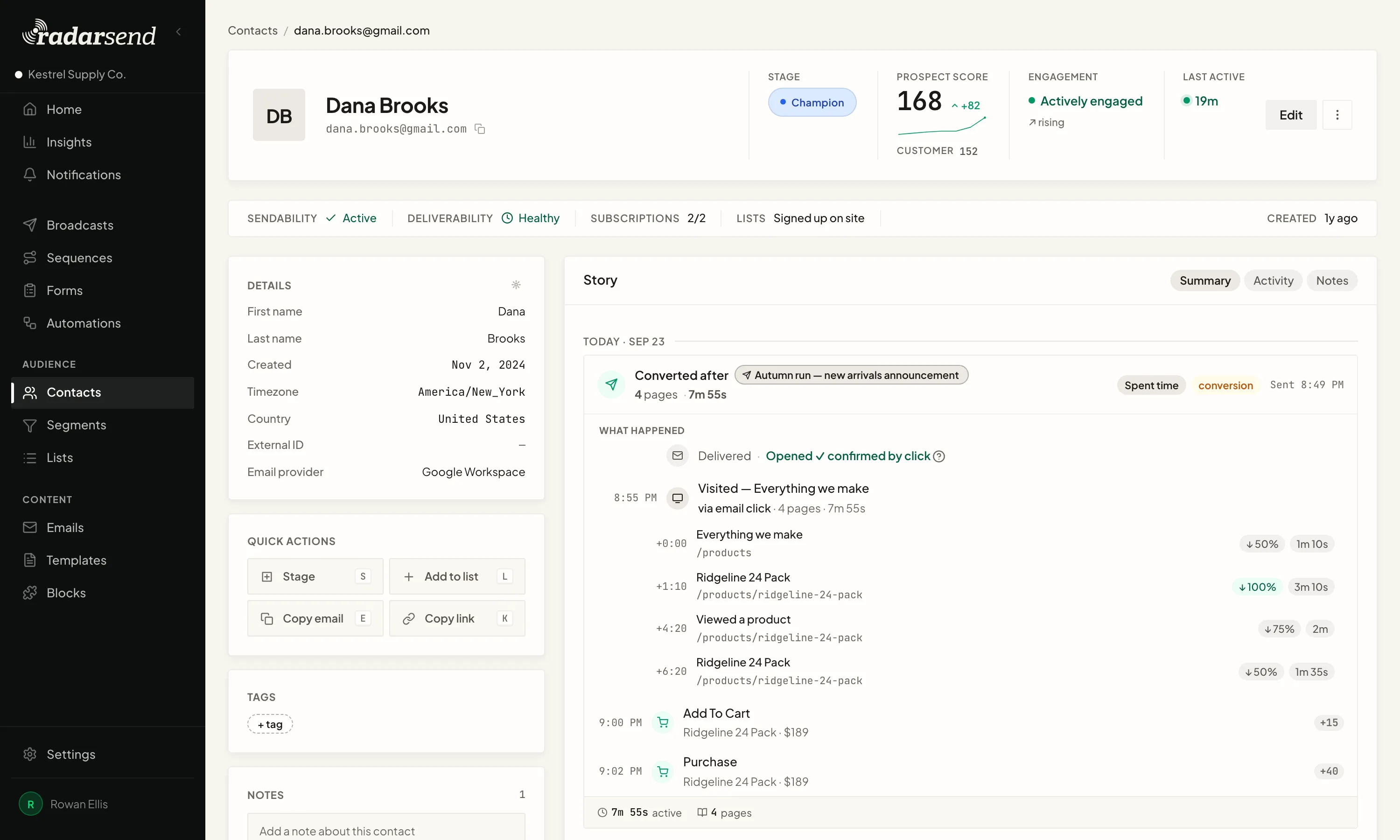
Most self-hosted tools know someone clicked. RadarSend knows they clicked, read three pages, spent nine minutes on the site, and came back two days later. That's a different signal than "clicked."
Follow-ups that respond to behavior.
Not drip timers — actual behavior. A pricing page visit triggers a follow-up three days later. A month of silence triggers a different angle. The sequence runs on its own once it's set up.
Audiences that stay current.
"Clicked three recent issues but never bought" is a segment described once. People join and leave as their behavior changes. The audience is fresh every time a broadcast sends.
Numbers that mean something.
Open rates on self-hosted tools include every Apple privacy proxy and Gmail pre-fetch. Click rates include every corporate security scanner. RadarSend classifies every interaction — likely human, maybe human, or machine — and shows both numbers on every report.
Scores and engagement.
Who's actively reading? Who's cooling off? Who clicked everything last month and hasn't been back? A score and an engagement tier per contact, each traceable to the activity that caused it.
It's not free. Here's what the cost looks like.
Self-hosted tools are free or close to it. RadarSend starts at $49/month (annual) for up to 10,000 contacts — $79 at 25,000, $129 at 50,000. That's a real increase.
What that buys: automation, behavioral segmentation, contact intelligence, bot filtering, site tracking, scoring, A/B testing, domain warming, a branded preference center, a full API, and hosted infrastructure that doesn't need maintaining.
What stays the same: the sending provider, the domains, the reputation, the rate, the control over what gets sent.
What goes away: the server, the cron jobs, the upgrades, the guesswork about whether the numbers are real.
The SES bill is the same either way. If broadcasting is the whole job and the server isn't a problem, Sendy or Listmonk will keep working. But if you need automation, segmentation, scoring, and honest metrics on the same sending provider — that's what $49/month gets you.
Own your sending. Get everything else.
Same provider. Same domains. Same reputation. No server. Everything else is new — automation, segmentation, scoring, and honest metrics.
RadarSend was built by people who ran their own sending for years and got tired of not having those things.
Pick the path that fits
Coming from Listmonk?
Same sending provider, same control — plus automation, scoring, and honest metrics.
Built something custom on SES?
RadarSend adds automation, segmentation, and honest metrics to the provider you already run.