Everything Listmonk wasn't built to do.
Listmonk sends broadcasts through your own provider. RadarSend connects to the same provider — and adds automation, segmentation, and honest metrics.
With Listmonk, you can blast a list.
It's clean, fast, and free. For a self-hosted mailing list, it's one of the best options out there.
No sequences or automation
No behavioral segmentation
No bot filtering on opens or clicks
No per-contact activity timeline
No lead scoring
Blast only.
RadarSend uses the same provider. It adds automation, segmentation, and honest metrics.
Sequences that follow up based on behavior. Segments that build themselves. A contact record with a real timeline. A/B testing, lead scoring, site tracking, domain warming. And every number filtered so the bots don't count.
What doesn't change.
Your sending provider.
You already run your own sending — SES, SendGrid, Mailgun, whatever you connected to Listmonk. RadarSend connects to the same provider. Mail goes out on your account, at your rate, building reputation on your domains.
Your domains.
Tracked links, opens, and the unsubscribe page all run on your domain. No shared vendor domain. Recipients never see RadarSend's name.
Your control.
RadarSend doesn't review your content, doesn't enforce double opt-in, and doesn't freeze your account because an algorithm got nervous. You run your list.
What Listmonk can't do.
Listmonk sends a broadcast and shows you aggregate numbers. RadarSend sends the broadcast, tracks what each person did next, follows up automatically, and filters the bots out of every report.
Automatic follow-ups based on behavior.
Someone clicks a link in your newsletter and visits your pricing page. Three days later, if they haven't come back, RadarSend sends a follow-up. If they have, it sends a different one. Listmonk doesn't have sequences or automation — when the broadcast is sent, the job is done.
Audiences that update themselves.
"Clicked three recent issues but never bought." "Visited the site twice this week." "Score above 50, then went quiet." In Listmonk, you manage static lists. In RadarSend, you describe the audience you want, and it stays current as people's behavior changes.
A real record for each person.
Open a contact in RadarSend and you see everything — every email you sent them, what they opened, what they clicked, which pages they read on your site, how long they stayed, their score, and whether their engagement is rising or fading. Listmonk shows an email address, some attributes, and which lists they're on.
Scoring, testing, site tracking, API.
Prospect and customer scores, each traceable to specific actions. A/B testing on subjects, bodies, senders, or providers — compared on human clicks, not raw numbers. First-party site tracking tied to named people. A full REST API with webhooks and MCP.
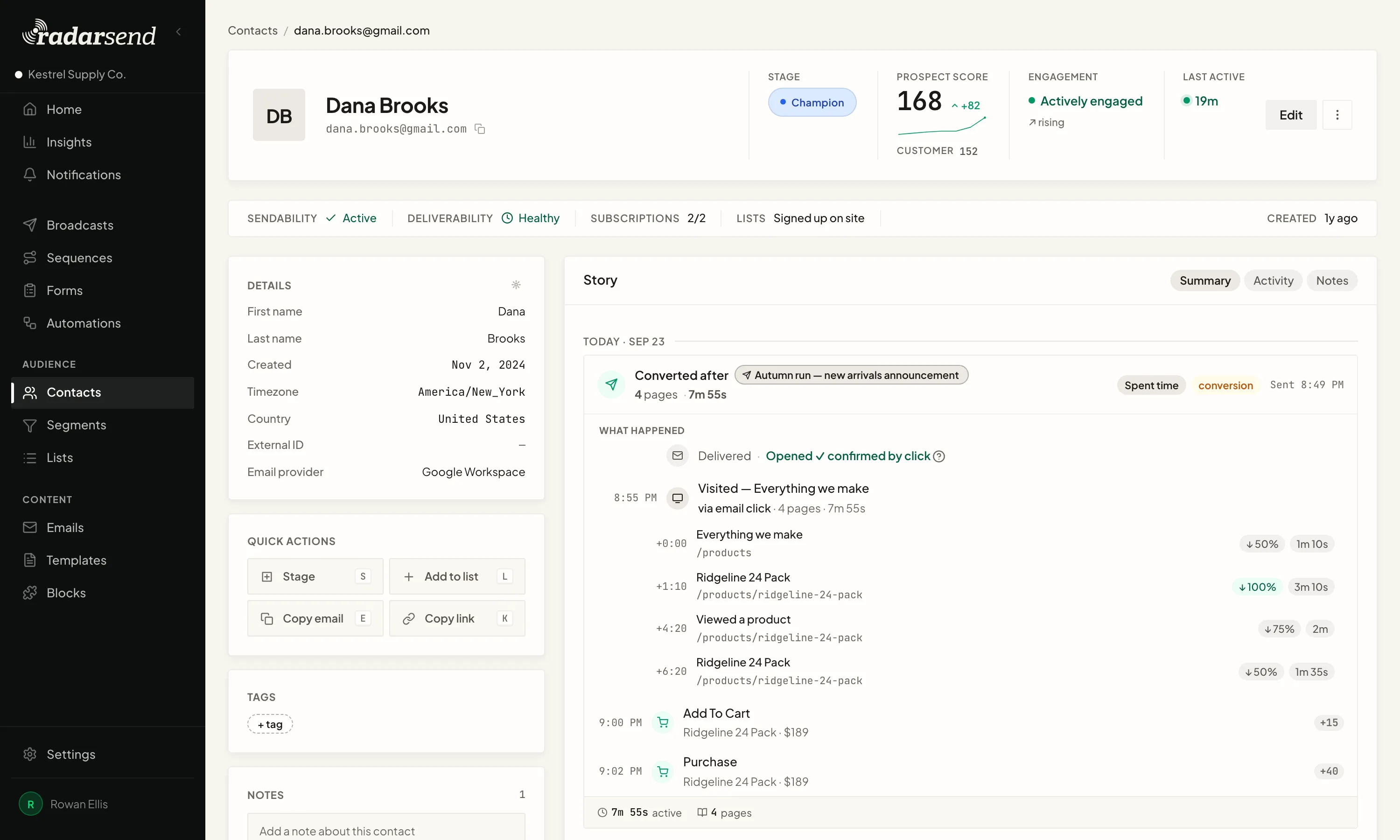
Your numbers have the same problem every tool has.
Apple Mail Privacy Protection opens every email before the recipient sees it. Corporate security gateways click every link. In Listmonk, all of that counts as real engagement. The open rate that looks like 50%? Some of it is machines.
This isn't a Listmonk-specific failure — almost every email tool has the same problem. RadarSend classifies every interaction — likely human, maybe human, or machine — and shows you both numbers on every report. Your scores, segments, and automation branches use the filtered data.

The server isn't why you'd switch.
Listmonk is lean. It's a Go binary and a PostgreSQL database. Compared to other self-hosted tools, it's a breeze to host. If you enjoy running your own infrastructure and your VPS is already doing other things, the ops burden is manageable.
But it's still a server — updates, backups, SSL, and the occasional thing that breaks. RadarSend is fully hosted. Your sending provider stays yours. The automation, segmentation, scoring, and bot filtering are our job.
If the server isn't the pain point for you, that's fine. The reason to switch isn't "stop running a server" — it's "start doing everything Listmonk can't."
Listmonk is free. The sending provider and the server are not.
Most people who run Listmonk aren't doing it to save money — they're doing it because they want to own their sending. RadarSend keeps that control and adds a lot more than broadcasting. Starting at $49/month:
Your SES bill stays the same. Your server bill goes away. And for less than the cost of a VPS, you get automation, segmentation, scoring, bot filtering, and site tracking on the same sending provider you already chose — with the same control you chose it for.
Keep the control. Add everything else.
Import your subscribers, lists, custom attributes, and suppressed addresses. Your sending provider stays exactly where it is — connect the same SES account, or pick from six other providers.
Your Listmonk instance can stay running during the transition — switch when you're ready, not on a deadline. If you have questions about your setup, we'll walk through it with you.