You should be able to tell
a human from a machine.
Security scanners and inbox previews often open and click an email before a person sees it. Counted as engagement, that activity inflates your opens, fakes your clicks, can crown the wrong A/B winner, and can start follow-ups nobody asked for.

Every open, click, and visit is classified, and known machine activity is filtered out before it counts.
What stays honest without the bots
Your open rate.
It counts people. When it goes up, something actually worked.
Your segments.
"Clicked twice this week" means a person clicked twice this week, so the list you're about to email is the list you think it is.
Your scores.
Machines earn nothing. A contact near the top is someone who's actually paying attention.
Your A/B tests.
Bots click too. If they're in the count, they get a vote on which version looks like the winner.
Your automations.
A follow-up goes out when a person acts, not when a scanner trips a link. Nobody gets a "thanks for your interest" because their firewall opened your email.
How we tell them apart.
Plenty of real people read your email from behind corporate mail systems. Plenty of bots don't come from anywhere that looks suspicious. A domain lookup can't tell them apart.
So RadarSend analyzes more than twenty signals on every open, click, and visit: how fast it came, whether every link was hit at once, whether it came from someone's phone or a data center, whether a browser ever actually drew the page, and whether anything human happened afterward.
It isn't a yes-or-no answer. Machine activity usually gives itself away. People are harder to prove, so RadarSend says how sure it is: likely a person when everything lines up, maybe when the signals are mixed. If the evidence isn't in yet, it waits.
Reasons to doubt it was a person
Proof it was a person.
When someone really does read your email, they leave traces a scanner rarely produces. Those count for more than anything on the other side.
See what was removed and why.
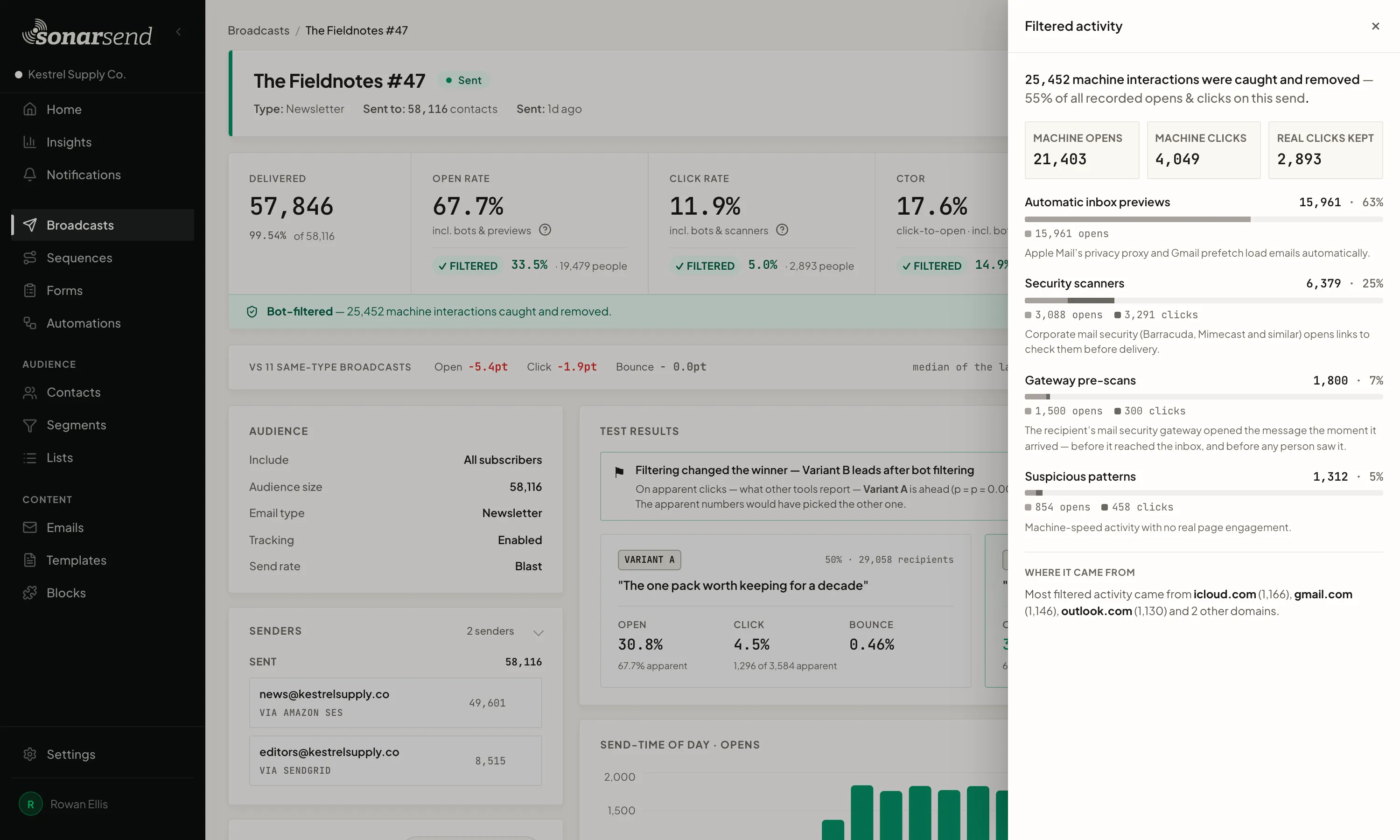
Open the filtered-activity drawer on any broadcast and RadarSend breaks down exactly what was caught. How many automatic inbox previews. How many security scanner clicks. How many gateway pre-scans. How many suspicious patterns. Which domains they came from.
Not a black box. You can see what was removed, why, and where it originated. You can inspect the same thing on an individual contact.
Don't let the machines pick the winner.
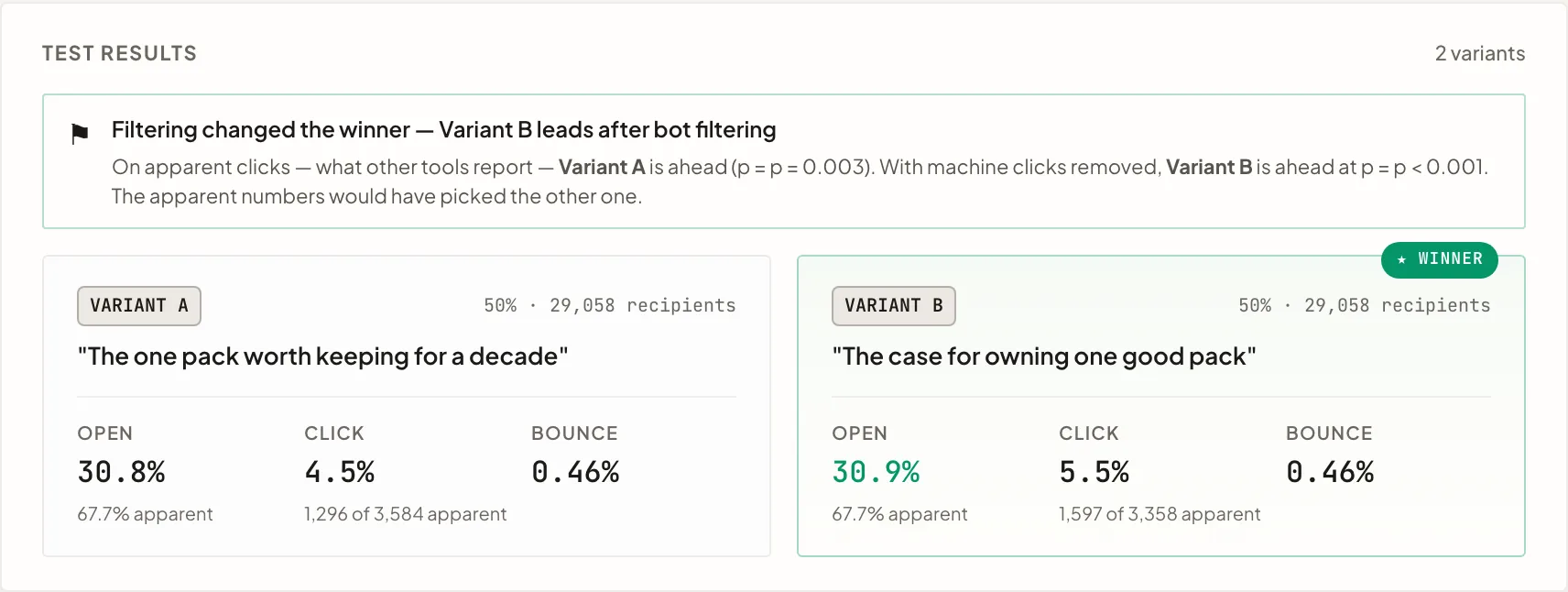
RadarSend compares A/B variants using filtered clicks and apparent clicks separately.
When both versions point to the same winner, the result is straightforward. When they disagree, the report says so plainly. The email that attracted more scanner clicks doesn't get mistaken for the email that worked better with people.
Filter once. Use the same answer everywhere.
Bot filtering isn't something applied only to a campaign report. The same classification follows the activity into segments, contact scores, and automations.
A machine click doesn't increase a score, add someone to an engaged segment, send them down an interested branch, or complete a sequence goal.
Reports, segments, contact records, and automation all read the same classification. If the foundation is noisy, everything built on it is noisy too.