Your newsletter deserves to scale without costing a fortune.
You built an audience. You send regularly. The content is the product — or it drives the product. The last thing you need is an email platform whose bill scales to thousands a month because the list is working.
RadarSend separates the platform from the sending. You pay a platform fee based on list size, and your sending provider charges you directly — at commodity rates. The total is a fraction of what the big platforms charge for the same list.
Most email platforms weren't built for newsletters.
They were built for e-commerce drips and abandoned-cart reminders. The pricing scales with the list because that's how stores think — more contacts, more revenue, higher bill is fine. It doesn't work the same way for a newsletter where every subscriber is a reader, not a buyer waiting to convert. The bill can climb to thousands a month with nothing to show for it but a bigger audience.
Newsletter senders hit the ceiling in three places: the bill scales faster than the revenue, the engagement numbers include machines that never read a word, and the platform owns the sending reputation you spent years building. If you leave, the reputation stays behind.
What matters when the newsletter is the business.
Broadcasting works everywhere. These are the things that separate a newsletter that's growing from one that's guessing.
Who's actually reading.
Open rates on most platforms include Apple privacy proxies, Gmail pre-fetches, and corporate security scanners. A 45% open rate might be 20% real readers. RadarSend classifies every interaction so the numbers reflect people, not bots.
What they do after the click.
Most platforms know someone clicked a link. RadarSend knows they clicked, read three pages, spent nine minutes on the site, and came back two days later. For a newsletter that drives revenue through content, that's the difference between "someone clicked" and "someone's interested."
Audiences that update themselves.
"Opened three of the last five issues" is a segment you describe once. People join and leave as their behavior changes. Use it to send a re-engagement series to people who stopped reading, or a premium offer to the ones who read everything.
Which content works.
A/B test subject lines, preview text, or sending time. See which variant gets real human engagement, not which one the bots liked. The winner sends automatically.

Same list size, a fraction of the cost.
RadarSend tiers by contacts — just like other platforms. The difference is how much you actually pay. On Mailchimp or ActiveCampaign, the bill can scale to hundreds or thousands a month as the list grows. On RadarSend, the platform fee is lower at every tier and the sending goes through your own provider at commodity rates — about $0.16 per 1,000 emails on SES Essentials.
At 50,000 subscribers, Mailchimp Standard costs roughly $350/month. ActiveCampaign is in the same range. RadarSend plus SES is roughly $144.
The gap gets wider as the list grows. At 100,000 subscribers, a typical platform charges $600–$1,200/month. RadarSend plus SES is roughly $274. That's $300–$900 per month back into content, promotion, or hiring.
No features are locked behind a higher tier. Automation, segmentation, scoring, A/B testing, site tracking, bot filtering — all included on every plan.
The sending account, the domains, and the reputation are yours.
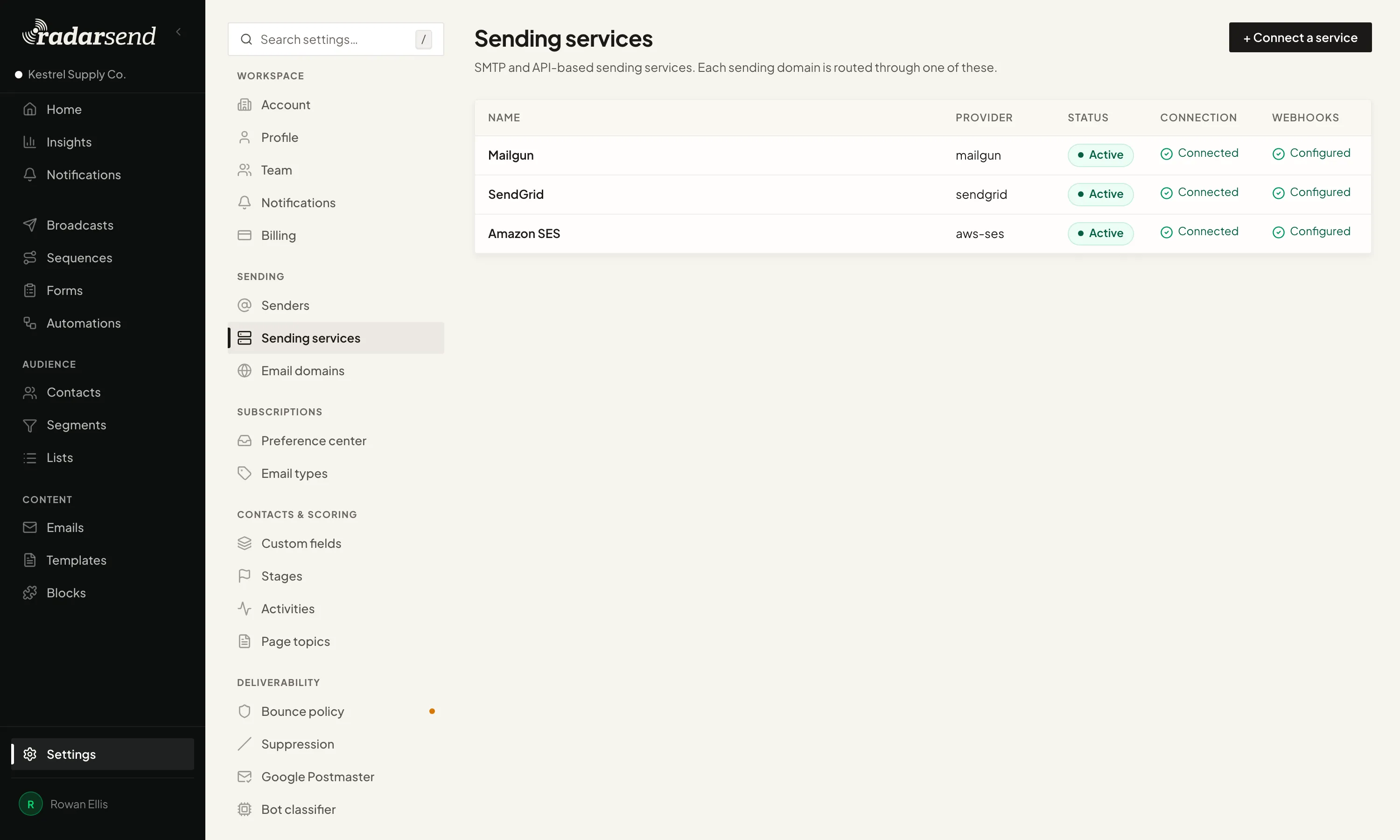
RadarSend connects to Amazon SES, SendGrid, Mailgun, Mailjet, or Resend. Mail goes out on your account, from your domains, building your reputation. Tracked links and unsubscribe pages run on your subdomain. Recipients never see RadarSend's name.
If the relationship ends, the sending account comes with you. The domains, the reputation, the subscriber list — none of it is locked in.
The platform's infrastructure.
Your account, your domains, your reputation. That's how it should work.
Write it yourself, or let your AI assistant assemble it.
Newsletter senders have opinions about their emails. RadarSend doesn't fight that. Use the template system for consistent layouts, write MJML for responsive emails that work everywhere, or paste raw HTML if that's how you work. Merge tags, conditional blocks, preview text, and a real preview across clients.
Or skip the assembly entirely. RadarSend's MCP server connects to Claude, ChatGPT, Gemini, or any AI assistant that supports MCP. Point the assistant at your blog, your website, or a set of links. It reads your RadarSend template — which fields go where, how long, which image slots, which content blocks — fills everything in, and RadarSend validates the result. Anything that doesn't fit gets flagged so the assistant can fix it and try again.
The result isn't a file to paste somewhere. It's a finished draft in your account, in your design, ready to preview and schedule. Two hours assembling a newsletter becomes a few minutes approving one.
What's different.
You connect a sending provider you already trust.
Amazon SES takes about fifteen minutes to set up. SendGrid, Mailgun, Mailjet, and Resend work too. The reputation builds on your account, and the cost difference starts with the first send.
Every feature on every plan.
Automation, segmentation, scoring, A/B testing, site tracking, bot filtering. Nothing is locked behind a more expensive tier. RadarSend starts at $49/month (annual) for up to 10,000 contacts.
Templates that know their own rules.
MJML, HTML, or the template system — write emails however you want. Templates define which fields go where, how long, which image slots. Your team and your AI assistant both work inside the same guardrails.
Built to connect.
Full REST API, signed webhooks, a WordPress plugin, and MCP for AI assistants. If you need something connected that isn't covered, get in touch.
Your newsletter deserves to scale without costing a fortune.
Real engagement numbers. A sending reputation you own. A total cost that's a fraction of what the big platforms charge for the same list size. Everything a newsletter needs — automation, segmentation, A/B testing, site tracking — without a bill that scales to thousands a month.
If you have questions about your specific setup — list size, sending provider, migration — we'll walk through it with you.